 CatchClock
Largemouth vs smallmouth bass: how to tell them apart
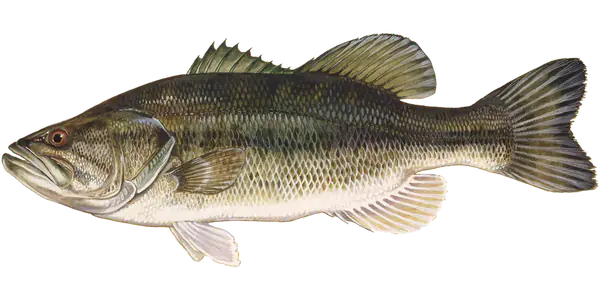
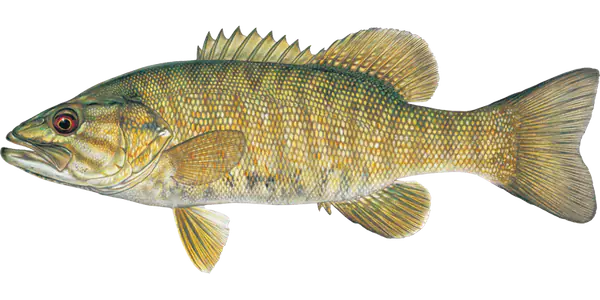
Largemouth and smallmouth bass are told apart at the jaw. With the mouth closed, a largemouth’s upper jaw reaches far beyond the rear margin of the eye; a smallmouth’s reaches only to about that margin. Two more marks confirm it: a largemouth carries one broad, dark stripe along the middle of its side, and a smallmouth has no stripe at all, only a series of separate vertical bars.
The two also choose different water — warm and still for the largemouth, cool and clear over rock for the smallmouth — yet some lakes hold both, and that is where the field marks earn their keep.
Largemouth vs smallmouth bass side by side
Every row below comes from the Missouri Department of Conservation’s field guides for largemouth bass and smallmouth bass. Missouri lists four key identifiers for a smallmouth: the jaw, the joined dorsal fins, the vertical bars and the small cheek scales.
| Field mark | Largemouth bass | Smallmouth bass |
|---|---|---|
| Upper jaw | Reaches far beyond the rear margin of the eye, except in small young | Reaches to about the rear margin of the eye, not beyond it |
| Side | One broad, dark, continuous stripe along the midside | No horizontal stripe; a series of separate vertical bars over faint mottling |
| Dorsal fins | Not well connected | Connected |
| Cheek scales | The same size as the body scales | Much smaller than the body scales |
| Tongue | Smooth | Usually a rough patch |
| Color | Greenish above, white below | Greenish brown above, whitish belly with dusky pigment |
| Everyday size | 10–20 in, ½–4½ lb | 10–20 in, ½–4 lb |
| Missouri maximum | About 24 in and 15 lb | About 22 in and 6 lb |
| Lifespan | 10 to 15 years | Up to about 10 to 12 years |
How to tell them apart in four checks
The checks run in the order that settles most fish soonest. The fourth is for the case the first one cannot handle: Missouri’s guide makes the jaw rule an adult rule, and small young largemouth do not follow it.
Step 1
Close the mouth and read the jaw
Follow the upper jaw back. Far past the rear of the eye is a largemouth; level with the rear of the eye is a smallmouth.
Step 2
Look along the side
One broad dark stripe along the middle of the side means largemouth. No stripe and a row of separate vertical bars mean smallmouth.
Step 3
Check where the dorsal fins meet
Fins that look almost separate belong to a largemouth. Two dorsal fins joined into one belong to a smallmouth.
Step 4
Settle a small fish at the cheek
Cheek scales much smaller than the body scales mark a smallmouth; on a largemouth they are the same size. A smooth tongue points to largemouth.
Two columns are the wrong frame wherever spotted bass live. Missouri’s field guide gives the spotted bass a largemouth’s broad dark side stripe and a smallmouth’s jaw, joined dorsal fins, small cheek scales and rough tongue. A fish with a side stripe, rows of dark spots below it and a jaw that stops at the eye is a spotted bass, and the bass family guide sorts it from the other black basses.
The Missouri spotted bass guide adds why this matters beyond naming a fish: in large Ozark reservoirs spotted bass outnumber smallmouth, and introduced spotted bass tend to replace smallmouth through hybridization and competition.
Largemouth bass: warm, still water
Largemouth Bass
Micropterus nigricans · Centrarchidae
- Freshwater
- Small fish
0.5 lb · 12 in
- Large fish
4.5 lb · 20 in
- Record fish
15 lb · 30 in
- Lifespan
Up to 15 years
Varies by water and conditions.
- Life cycle
Freshwater
Lives in fresh water its whole life.
- Diet
Predator
Feeds on fish, crayfish, large insects and frogs.
Data as a table
| Fish | Weight | Length |
|---|---|---|
| Small fish | 0.5 lb | 12 in |
| Large fish | 4.5 lb | 20 in |
| Record fish | 15 lb | 30 in |
| Fact | Value |
|---|---|
| Lifespan | Up to 15 years |
| Life cycle | Freshwater |
| Diet | PredatorFeeds on fish, crayfish, large insects and frogs. |
Missouri’s field guide finds largemouth in lowland lakes, artificial impoundments of all sizes, permanent pools of streams and the quiet backwaters of large rivers, and describes a fish that thrives in warm, moderately clear water with little or no current. It eats fish, crayfish and large insects, and occasionally frogs, mice, snakes or other small animals that fall into the water. The same guide calls it almost invariably the principal predator stocked in farm ponds.
Smallmouth bass: cool, clear water over rock
Smallmouth Bass
Micropterus dolomieu · Centrarchidae
- Freshwater
- Small fish
0.5 lb · 11 in
- Large fish
4 lb · 18 in
- Record fish
11 lb · 27 in
- Lifespan
Up to 12 years
Varies by water and conditions.
- Life cycle
Freshwater
Lives in fresh water its whole life.
- Diet
Predator
Feeds on fish, crayfish and large aquatic insects.
Data as a table
| Fish | Weight | Length |
|---|---|---|
| Small fish | 0.5 lb | 11 in |
| Large fish | 4 lb | 18 in |
| Record fish | 11 lb | 27 in |
| Fact | Value |
|---|---|
| Lifespan | Up to 12 years |
| Life cycle | Freshwater |
| Diet | PredatorFeeds on fish, crayfish and large aquatic insects. |
Missouri’s smallmouth live mostly in cool, clear Ozark streams and large Ozark reservoirs, and the field guide describes a fish that thrives over silt-free rock or gravel, near riffles but not in the main current. Farther north in its range it lives in natural lakes and ponds as well. It eats fish, crayfish and large aquatic insects, and the guide records smallmouth following a large turtle or sucker as it roots in the bottom, pouncing on whatever it disturbs.
Spawning: the same spring, different nests
The two seasons overlap in Missouri, and both fish keep the nest out of current. Where they differ is the nest itself and how fast the eggs hatch:
| Spawning | Largemouth bass | Smallmouth bass |
|---|---|---|
| Season in Missouri | Mid-April through late May or June | Early or mid-April, once water passes 60°F, into June or July; peak in May |
| Nest site | Rock or gravel preferred, any firm, silt-free bottom | Quiet water near shore, or downstream of a boulder that breaks the current |
| Depth and cover | Under 1 foot to 15 feet or more of water | Not far from cover or deeper water, where the male retreats when frightened |
| Current | No nests where current or waves are present | Nests where there is no perceptible current |
| Eggs | Hatch in 3–4 days | About 2,500 per nest on average, sometimes 10,000; hatch in 2–3 days |
| After hatching | Fry school over the nest and break up 26–31 days after hatching; Missouri rates the male a more attentive parent than any other sunfish | Fry stay at the nest about 12 days; the male guards nest and fry until they leave |
Very few of those smallmouth fry last until September.
80,000
Where each one lives
The two native ranges share the middle of the continent and part at the edges. The U.S. Geological Survey profile of largemouth bass places it natively in the St. Lawrence–Great Lakes, Hudson Bay and Mississippi basins from southern Quebec to Minnesota and south to the Gulf, along the Atlantic Slope from North Carolina to Florida, and along the Gulf Slope from southern Florida into northern Mexico. The USGS smallmouth profile gives it the same three northern basins, from southern Quebec to North Dakota, but only as far south as northern Alabama and eastern Oklahoma, plus Atlantic and Gulf slope drainages from Virginia to central Texas. Both have been stocked far outside those lines, and USGS keeps a state-by-state record of where each now lives as a nonindigenous fish.
Inside a range, the water decides which one you meet. Missouri’s two guides describe it like this:
| Water | Largemouth bass | Smallmouth bass |
|---|---|---|
| Typical home | Lowland lakes, impoundments of all sizes, stream pools, quiet river backwaters | Cool, clear streams and large reservoirs; natural lakes farther north |
| Current | Little or none | Near riffles, but not in the main current |
| Bottom | Nests on any firm, silt-free bottom, rock or gravel preferred | Silt-free rock or gravel |
| Water temperature | Warm | Cool |
| Most active | Dawn and dusk | Dawn and dusk |
The one row the two share is the one that sets the clock: both are most active at dawn and dusk, and the best fishing times guide ranks light level among the strong signals for that reason.
When both share the water
Most bass water on our grid holds one of the two. Of the 88 cities on the fishing forecast by city, 39 list largemouth among their target species, 22 list smallmouth, and 9 list both.
17%
In those nine, the two fish rarely peak together:
| City | Largemouth peak | Smallmouth peak |
|---|---|---|
| Nashville | Apr–May, Oct | Apr–May, Oct |
| St. Louis | Apr–May, Oct | May–Jun, Oct |
| Philadelphia | May–Jun, Oct | Jun–Jul, Sep |
| Las Vegas | May–Sep | Mar–Jun |
| Indianapolis | May–Jun | Aug–Oct |
| Santa Barbara | Apr–Jun | Mar–May |
| Spokane | Jun, Sep–Oct | May–Jun, Sep–Oct |
| Burlington | May–Jun | May–Jun |
| Cincinnati | Jun–Nov | Apr–May |
Nashville and Burlington are the two of the nine where the peaks match; at Burlington, Vermont Fish & Wildlife has both basses moving shallow together in spring and staging on gravel, chunk rock and ledge before the spawn. The smallmouth spring peak runs a month later than the largemouth one in St. Louis and Philadelphia, a month earlier in Santa Barbara and Spokane, and two months earlier in Las Vegas, where the Nevada Department of Wildlife lists both basses on Lake Mohave and advises fishing Lake Mead for largemouth in the early morning and evening from May through September. Indianapolis splits them by water: largemouth peak on the reservoirs in May and June, and the smallmouth months, August to October, belong to the White River, where Indiana’s DNR names late summer and fall as the time to fish rivers on foot. Cincinnati runs the other way on the Ohio River: Ohio’s Department of Natural Resources puts most trophy smallmouth from mid-April into early May and the main largemouth season from June through fall.
Which one grows bigger
Largemouth, by a wide margin at the top and none in the middle. Missouri’s field guides give both species the same everyday length of 10 to 20 inches; the gap opens at the maximum.
15 lb vs 6 lb
The cards above print the heaviest fish their own sources name — Missouri’s guide for the largemouth and Alabama’s state record for the smallmouth — and the tables under them say which source stands behind each number. The all-tackle world records, as the International Game Fish Association lists them, stand higher: 22 lb 4 oz for largemouth, set by George Perry in Georgia in 1932, and 11 lb 15 oz for smallmouth, from Dale Hollow Lake on the Tennessee–Kentucky line.
A new name for the largemouth
One of the two fish changed its scientific name. Largemouth bass is now Micropterus nigricans; the old name, Micropterus salmoides, passed to the Florida bass, which the American Fisheries Society now treats as a separate species. Florida’s Fish and Wildlife Conservation Commission adopted the change in July 2024 and said it would not affect anglers fishing for the fish. Smallmouth bass keeps Micropterus dolomieu. Older field guides print the old name, and Missouri’s prints both.
Fishing for one or the other
Missouri’s smallmouth guide says the same types of lures used for largemouth also take smallmouth, and names minnows, crayfish and hellgrammites as the most effective live baits. What changes is where the lure goes: silt-free rock near current for one, warm and still water for the other. Season-by-season tactics are in how to catch largemouth bass and how to catch smallmouth bass.
For timing the dawn and dusk hours on a particular lake, the comparison of fishing apps says which apps print solunar bite windows and which do not.