 CatchClock
Blue catfish vs channel catfish: how to tell them apart
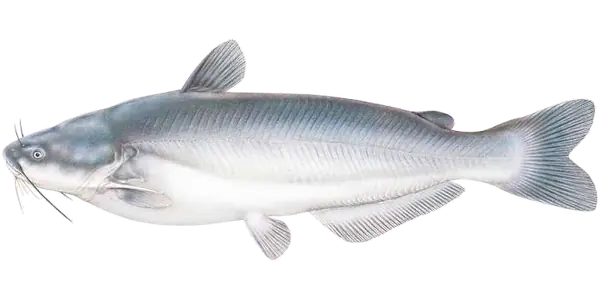
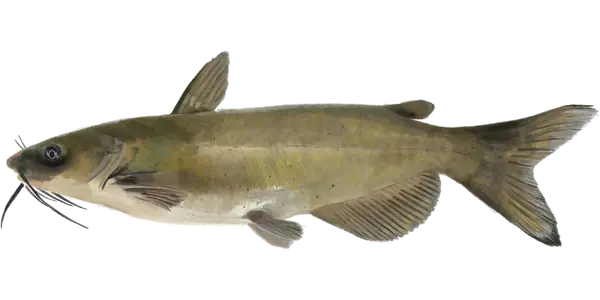
Blue catfish and channel catfish are told apart by the anal fin, the long fin on the underside in front of the tail. On a blue catfish its outer edge is straight and it carries 30 to 35 rays; on a channel catfish the edge is rounded and it carries usually 24 to 29. Color does not settle it, because channel catfish can be blue too.
Both have the deeply forked tail that sets them apart from the third big American catfish, the flathead, which is covered at the end of this page.
Blue vs channel catfish side by side
Every row comes from the Missouri Department of Conservation’s field guides for blue catfish and channel catfish, and the Texas Parks and Wildlife profile of the blue catfish gives the same ray count, 30 to 35.
| Field mark | Blue catfish | Channel catfish |
|---|---|---|
| Anal fin edge | Straight, tapering in a flat line like a barber’s comb | Rounded outward |
| Anal fin rays | 30–35 | Usually 24–29 |
| Anal fin base | Relatively longer | Relatively shorter |
| Dark spots | Never, in Missouri’s guide; Texas records spots only on its Rio Grande population | Scattered, but often absent on the smallest young and on large adults |
| Back, from the dorsal fin forward | Steep and straight, giving a wedge-shaped head | Gently sloping and slightly rounded |
| Color | Pale bluish silver above, silvery white below | Olive brown or slate blue above; breeding males deep blue-black |
| Everyday adult size | 20–44 in, 3–40 lb | 12–32 in, 1–15 lb |
| Top end in Missouri | Recent records 115–130 lb; fish near 100 lb still taken occasionally | Usually 35 lb at most; 45 lb is uncommon |
| Lifespan | At least 21 years in the wild | Usually not past 6 or 7 years, sometimes more than 10 |
| Spawning in Missouri | Late spring or early summer, probably May and June | Last week of May, at 75°F, to the third week of July |
How to tell them apart in four checks
The checks run from the one that sorts the most fish to the one that settles a close call. Spots, the mark most people look for first, are not on the list: Missouri notes they are often absent on the smallest young and the largest adults.
Step 1
Look at the tail
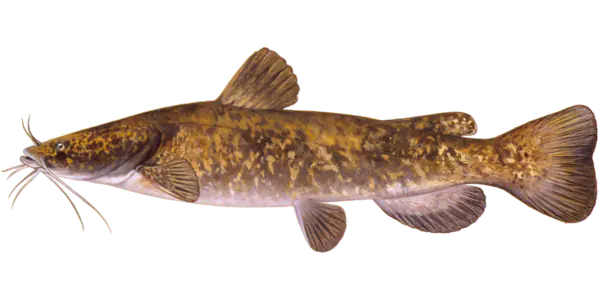
A deeply forked tail means blue or channel catfish. A squared tail with only a slight notch means flathead.
Step 2
Read the edge of the anal fin
A straight outer edge, like a comb, means blue catfish. An edge rounded outward means channel catfish.
Step 3
Count the anal rays if the edge is unclear
30 to 35 rays is a blue catfish. Usually 24 to 29 is a channel catfish.
Step 4
Check the head from the side
A back that rises steep and straight to the dorsal fin gives the blue catfish its wedge. A channel catfish slopes gently and rounds.
30–35
Spots and color are why the two get mixed up. Missouri’s guide gives the channel catfish a slate-blue back in some fish, deep blue-black breeding males and the local name blue cat, while the blue catfish answers to white cat and blue channel cat. Spots help only part of the time: the smallest young and the largest adult channel catfish often lack them.
No checklist settles every catfish. Missouri’s field guide records channel catfish mating with blue and flathead catfish and producing hybrids that blend traits of both parents, and Texas records spots on its Rio Grande blue catfish, the one population that breaks the no-spots rule. When the fin edge and the ray count disagree, no single mark decides it.
Blue catfish: big rivers, big fish
Blue Catfish
Ictalurus furcatus · Ictaluridae
- Brackish
- Freshwater
- Small fish
3 lb · 18 in
- Large fish
40 lb · 36 in
- Record fish
130 lb · 65 in
- Lifespan
Up to 21 years
Varies by water and conditions.
- Life cycle
Freshwater
Lives in fresh water its whole life.
- Diet
Predator
Feeds on fishes, immature aquatic insects, crayfish, fingernail clams and freshwater mussels.
Data as a table
| Fish | Weight | Length |
|---|---|---|
| Small fish | 3 lb | 18 in |
| Large fish | 40 lb | 36 in |
| Record fish | 130 lb | 65 in |
| Fact | Value |
|---|---|
| Lifespan | Up to 21 years |
| Life cycle | Freshwater |
| Diet | PredatorFeeds on fishes, immature aquatic insects, crayfish, fingernail clams and freshwater mussels. |
Missouri calls the blue catfish a big-river fish, preferring swift chutes, pools with noticeable current and silt-free sand, gravel and rubble, and moving with the seasons: down the lower Mississippi to warmer water in winter, upstream in summer. It grows faster than the channel catfish and nearly as fast as the flathead, and fish longer than 8 to 13 inches eat mostly fish and larger invertebrates.
NOAA Fisheries’ blue catfish profile adds the range outside its home rivers: stocked for fishing in almost 20 states, and invasive in the Chesapeake Bay, where the bay record is a 102-pound fish from the James River.
Channel catfish: the common one
Channel Catfish
Ictalurus punctatus · Ictaluridae
- Brackish
- Freshwater
- Small fish
1 lb · 12 in
- Large fish
15 lb · 24 in
- Record fish
45 lb · 50 in
- Lifespan
Up to 10 years
Varies by water and conditions.
- Life cycle
Freshwater
Lives in fresh water its whole life.
- Diet
Omnivore
Feeds on fish, insects, crayfish, mollusks and plant material.
Data as a table
| Fish | Weight | Length |
|---|---|---|
| Small fish | 1 lb | 12 in |
| Large fish | 15 lb | 24 in |
| Record fish | 45 lb | 50 in |
| Fact | Value |
|---|---|
| Lifespan | Up to 10 years |
| Life cycle | Freshwater |
| Diet | OmnivoreFeeds on fish, insects, crayfish, mollusks and plant material. |
The channel catfish is the most abundant and widely distributed large catfish in Missouri, at home in many kinds of water but especially in large, rather turbid streams of low or moderate gradient. Adults spend the day in deep water or around drift piles and logs and move onto riffles and into the shallows of pools at night to feed. They mature at about 4 or 5 years and 12 to 15 inches.
Missouri made it the state fish in 1997, and Kansas, Iowa, Nebraska and Tennessee have done the same. The same guide puts the best fishing near dusk and in the early part of the night, or on a rise after heavy rain — the low-light hours the best fishing times guide ranks among the strong signals.
35 lb
Flathead catfish: the square tail
Flathead Catfish
Pylodictis olivaris · Ictaluridae
- Freshwater
- Small fish
1 lb · 18 in
- Large fish
45 lb · 36 in
- Record fish
100 lb · 61 in
- Lifespan
Up to 26 years
Varies by water and conditions.
- Life cycle
Freshwater
Lives in fresh water its whole life.
- Diet
Predator
Feeds on fish, crayfish and other crustaceans.
Data as a table
| Fish | Weight | Length |
|---|---|---|
| Small fish | 1 lb | 18 in |
| Large fish | 45 lb | 36 in |
| Record fish | 100 lb | 61 in |
| Fact | Value |
|---|---|
| Lifespan | Up to 26 years |
| Life cycle | Freshwater |
| Diet | PredatorFeeds on fish, crayfish and other crustaceans. |
The Missouri flathead field guide leaves little room for confusion with the other two: a broad, flattened head with small eyes on top, a lower jaw that projects beyond the upper, a tail squared off with a slight notch and a lighter upper tip, and a rounded anal fin of 14 to 17 rays. Adults commonly run 15 to 45 inches, the maximum is about 100 pounds, and among Missouri’s catfishes only the blue grows larger. Flatheads take only live or freshly killed bait, and they spawn later than channel catfish, in late June and July.
Where each one lives
The channel catfish has the widest native range of the three: Missouri’s guide runs it from southern Canada through the eastern United States east of the Rocky Mountains into northeastern Mexico. The U.S. Geological Survey profile of the blue catfish gives it the Mississippi River basin from western Pennsylvania to southern South Dakota and south to the Gulf, plus Gulf tributaries from Mobile Bay to the Rio Grande. The USGS flathead profile covers the Mississippi basin to North Dakota and the Gulf Slope from the Mobile Bay drainage to Mexico.
On the fishing forecast by city, the three split cleanly. Of 88 cities, 19 list at least one of them among their target species, and none lists both blue and channel catfish.
22%
| City | Catfish on the list | Peak months |
|---|---|---|
| St. Louis, MO | Blue | May–Jun, Sep–Oct |
| Memphis, TN | Blue and flathead | May–Jun, Sep–Oct (blue); Jun–Aug (flathead) |
| Oklahoma City, OK | Blue | May–Jun, Sep–Oct |
| Charleston, SC | Blue | May–Jun, Sep–Oct |
| Dallas, TX | Blue | May–Jun, Oct–Nov |
| Baltimore, MD | Blue | May–Aug |
| Columbus, OH | Blue | Jun–Aug |
| Richmond, VA | Blue | Apr–Jun |
| Tulsa, OK | Blue and flathead | Mar–May (blue); May–Jul (flathead) |
| Nashville, TN | Channel | Jun–Aug |
| Detroit, MI | Channel | Jun–Aug |
| Sacramento, CA | Channel | May–Aug |
| Charlotte, NC | Channel | Apr–May, Sep–Oct |
| Austin, TX | Channel | Apr–Jul, Sep–Oct |
| Omaha, NE | Channel | Mar, Aug |
| Philadelphia, PA | Flathead | Jun–Aug |
| Wichita, KS | Flathead | Jun–Aug |
| Phoenix, AZ | Flathead | Jun–Aug |
| Little Rock, AR | Flathead | Jun–Jul |
Five of the nine blue catfish cities name a spring window and an autumn one, while three of the six channel catfish cities peak through summer; Charlotte and Austin name a spring window and an autumn one, and Omaha names March and August. The blue catfish cities sit on big rivers, big reservoirs and the tidal rivers where the fish was stocked: the Mississippi at St. Louis and Memphis, the Chesapeake tributaries behind Baltimore and the tidal James at Richmond, the Cooper River above Charleston, and Hoover Reservoir at Columbus, where Ohio first stocked them in 2011. Channel catfish lead the list at Nashville, Detroit, Sacramento and Charlotte. Flathead catfish join the list at Little Rock, on the Maumelle rivers below Lake Maumelle, and at Tulsa, where Oklahoma’s Department of Wildlife Conservation finds them nesting in Keystone Lake’s rocky bluffs from May through July.
Which one is better to eat
Neither agency ranks them. Missouri credits the blue catfish with firm, well-flavored flesh and calls it a highly valued food fish, and it calls the channel catfish one of the state’s most highly prized game and food fishes; Missouri’s catfish farming industry is the commercial propagation of channel catfish. NOAA Fisheries calls blue catfish quite tasty and a good source of nutrition, and in parts of the Chesapeake anglers are asked to keep them rather than release them. Consumption advisories are set by state and by water, and they apply to both fish.
Fishing for one or the other
The baits follow the diets. Missouri lists a long menu of live, cut and prepared baits for channel catfish, from worms and liver to stinkbait, while many blue catfish anglers prefer gizzard shad and skipjack herring above all other baits. The bait-by-species table and the rigs for each are in how to catch catfish, and the comparison of fishing apps says which apps print the night and low-light windows both fish feed in.