 CatchClock
What do catfish eat? Channel, blue and flathead diets
Wild catfish eat fish, crayfish, insects, clams and mussels, and channel catfish add plants and dead animal matter to that list. What one particular catfish eats depends first on its species and then on its size: all three American catfish start life on insects and other small invertebrates, and two of them finish it as fish-eaters.
This page covers wild channel, blue and flathead catfish, and the channel catfish people stock in farm ponds. Aquarium catfish such as corydoras and plecos belong to other families and need aquarium feeding advice instead.
What catfish eat, species by species
The Missouri Department of Conservation keeps a field guide for each of the three species, and the three diets line up like this. The column that matters most to an angler is the last one, taken from the same agency’s catfish fishing tips: it says whether dead bait has any chance at all.
| Species | What it eats | Small fish eat | Dead or cut bait |
|---|---|---|---|
| Channel catfish | Fish, insects, crayfish, mollusks and plant material | Under 4 inches, almost entirely small insects | Yes — it scavenges dead animal matter, and prepared baits and chicken liver work |
| Blue catfish | Fishes, immature aquatic insects, crayfish, fingernail clams and freshwater mussels | Mostly small invertebrates; fish appear from about 4 inches | Yes — cut gizzard shad and skipjack herring are the usual baits |
| Flathead catfish | Adults prefer fish, crayfish and other crustaceans | Under 4 inches, insect larvae | Rarely — it is not a scavenger and clearly prefers live bait |
Size is the second switch. Blue catfish longer than 8 to 13 inches eat mostly fish and larger invertebrates, and adult flatheads hunt the same kind of prey. Only the channel catfish stays a generalist for life. The two forked-tail species are easy to confuse on the line, and the anal fin, not the color, settles blue catfish vs channel catfish.
Channel catfish eat almost anything
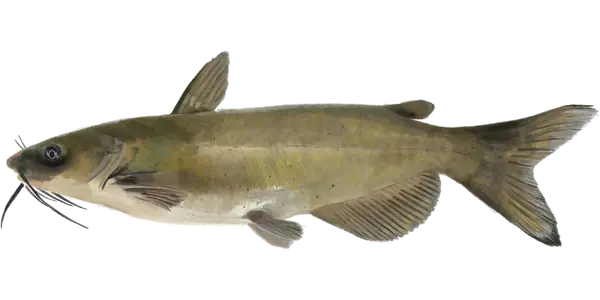
Channel Catfish
Ictalurus punctatus · Ictaluridae
- Brackish
- Freshwater
- Small fish
1 lb · 12 in
- Large fish
15 lb · 24 in
- Record fish
45 lb · 50 in
- Lifespan
Up to 10 years
Varies by water and conditions.
- Life cycle
Freshwater
Lives in fresh water its whole life.
- Diet
Omnivore
Feeds on fish, insects, crayfish, mollusks and plant material.
Data as a table
| Fish | Weight | Length |
|---|---|---|
| Small fish | 1 lb | 12 in |
| Large fish | 15 lb | 24 in |
| Record fish | 45 lb | 50 in |
| Fact | Value |
|---|---|
| Lifespan | Up to 10 years |
| Life cycle | Freshwater |
| Diet | OmnivoreFeeds on fish, insects, crayfish, mollusks and plant material. |
Channel catfish are the omnivores of the three. The Missouri field guide for the species lists fish, insects, crayfish, mollusks and plant material, and describes the fish searching stream bottoms, grazing on plants and cleaning up dead animal matter. Its diet varies greatly with size: fish under 4 inches feed almost entirely on small insects, and larger fish take larger food.
50
In bait terms, that breadth makes the channel catfish the one species of the three that every kind of bait suits. Missouri’s tips list prepared baits on a rubber worm, nightcrawlers, chicken liver, grasshoppers, crayfish and small fish for it — dead, alive and manufactured on the same list.
Blue catfish turn to fish as they grow
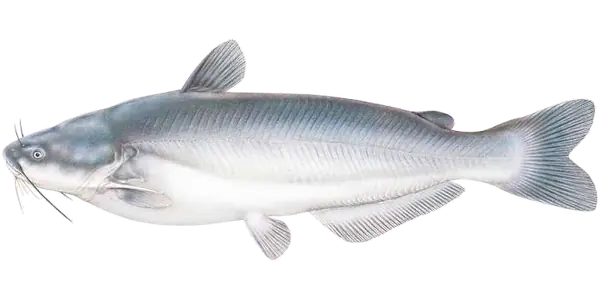
Blue Catfish
Ictalurus furcatus · Ictaluridae
- Brackish
- Freshwater
- Small fish
3 lb · 18 in
- Large fish
40 lb · 36 in
- Record fish
130 lb · 65 in
- Lifespan
Up to 21 years
Varies by water and conditions.
- Life cycle
Freshwater
Lives in fresh water its whole life.
- Diet
Predator
Feeds on fishes, immature aquatic insects, crayfish, fingernail clams and freshwater mussels.
Data as a table
| Fish | Weight | Length |
|---|---|---|
| Small fish | 3 lb | 18 in |
| Large fish | 40 lb | 36 in |
| Record fish | 130 lb | 65 in |
| Fact | Value |
|---|---|
| Lifespan | Up to 21 years |
| Life cycle | Freshwater |
| Diet | PredatorFeeds on fishes, immature aquatic insects, crayfish, fingernail clams and freshwater mussels. |
Blue catfish feed mostly on or near the bottom and to a lesser extent in midwater, according to the Missouri field guide for blue catfish. Their diet is animal throughout: fishes, immature aquatic insects, crayfish, fingernail clams and freshwater mussels. A blue catfish as small as 4 inches may already eat some fish, but small blues live mostly on small invertebrates, and fish over 8 to 13 inches eat mostly fish and larger invertebrates. The same guide notes that in Virginia, blue catfish also appear to eat invasive hydrilla and Asian clams.
Outside their native range, that appetite became a management problem. The U.S. Geological Survey summarizes Chesapeake Bay stomach studies as a mix of crabs, clams, mussels and fish, and cites one estimate for a single tidal river.
401 tons
Menhaden matter beyond the catfish. The USGS fact sheet on invasive blue catfish names menhaden as a key food source for striped bass on the Atlantic coast, a fishery the same fact sheet credits with $500 million a year of Chesapeake Bay economic activity.
Flathead catfish hunt live prey
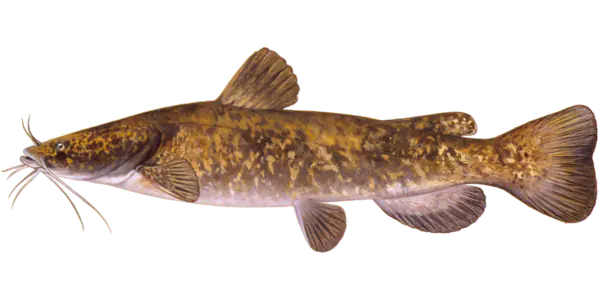
Flathead Catfish
Pylodictis olivaris · Ictaluridae
- Freshwater
- Small fish
1 lb · 18 in
- Large fish
45 lb · 36 in
- Record fish
100 lb · 61 in
- Lifespan
Up to 26 years
Varies by water and conditions.
- Life cycle
Freshwater
Lives in fresh water its whole life.
- Diet
Predator
Feeds on fish, crayfish and other crustaceans.
Data as a table
| Fish | Weight | Length |
|---|---|---|
| Small fish | 1 lb | 18 in |
| Large fish | 45 lb | 36 in |
| Record fish | 100 lb | 61 in |
| Fact | Value |
|---|---|
| Lifespan | Up to 26 years |
| Life cycle | Freshwater |
| Diet | PredatorFeeds on fish, crayfish and other crustaceans. |
Flathead catfish are the predators of the family. The Missouri field guide for flatheads puts small fish under 4 inches on insect larvae and adults on fish, crayfish and other crustaceans. Unlike channel catfish, flatheads are not scavengers and rarely eat dead or decaying material.
They also keep the strictest hours. Flatheads forage at night, and adults move from deeper water or cover onto riffles and into the shallows of pools to feed. A dead bait set at noon fails twice over: wrong food, wrong hour.
How a catfish finds its food
Catfish find food by smell and taste more than by sight. Missouri’s field guides describe channel and blue catfish locating food with their sensitive barbels, and the channel catfish guide adds chemosensory receptors for smell and taste. Fishing a bait still and letting current carry its scent downstream works with that sense rather than against it.
Night is when it pays off. Channel catfish feed at night in the shallows of pools and on riffles, and flatheads forage at night, so the light level does more for a catfish trip than any calendar does — the best fishing times guide ranks light level among the strong signals for exactly this reason. Night windows for specific waters sit on the fishing forecast by city.
A diet list is an average over many stomachs in many waters. The catfish in front of you eats what its own water holds that season — crabs in a tidal Chesapeake river, insects and crayfish in a Missouri stream — and no species table replaces looking at what actually lives there.
What catfish eat in a pond
Pond catfish start on the same menu as wild ones. The Missouri Department of Conservation’s channel catfish pond guide says channel catfish eat a variety of plant and animal matter, and that young catfish, sometimes called fiddlers, feed mainly on aquatic insects, snails, crawfish, green algae, aquatic plants, seeds and small fish. A pond is never empty of catfish food, but it holds only so much: without feeding, the same guide stocks 100 to 300 catfish per surface acre, and more only where they will be fed.
That is where pellets come in. The Missouri guide recommends floating pellets because you can see the fish eat them: feed no more than the fish take in about 15 minutes, feed in late morning once oxygen has recovered from its overnight low, and feed at the same time and place in water three to four feet deep. A sudden drop in feeding can be the first sign of disease or poor water quality. How often to feed follows the surface water temperature:
| Surface water temperature | How often to feed |
|---|---|
| Under 45°F | Do not feed |
| 45–50°F | Once a week |
| 51–55°F | Twice a week |
| 56–65°F | Every other day |
| 66–90°F | Every day |
| Over 90°F | Do not feed |
The schedule was written for Missouri farm ponds, where the same guide puts optimum catfish growth at about 85°F. On feed strength, Mississippi State University Extension is specific.
28%
The same page notes that once a pond is fed, natural food contributes relatively little of the nutrition — the pellets are doing the growing.
From diet to bait
Bait is diet translated into tackle. Channel catfish take almost anything with scent; blue catfish past the size where they turn to fish want fish, live or cut; flatheads want prey that is still alive. The bait-by-species table, with the seasons when each one earns its place, is in how to catch catfish, and catfish sit in the wider species-by-water picture in how to catch fish.
For timing a trip around night feeding rather than reading about it, the comparison of fishing apps says which apps print solunar bite windows and which do not.