 CatchClock
Pickerel vs pike: how to tell chain pickerel from northern pike
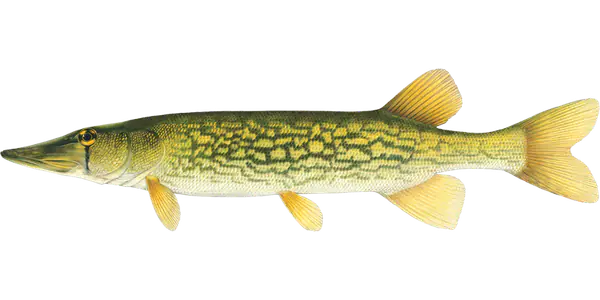
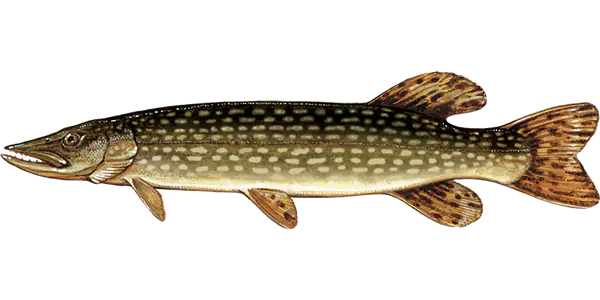
A pike and a pickerel wear the same pattern in reverse. A northern pike has light, roundish yellow spots on a dark green body; a chain pickerel has dark, chain-like lines on a lighter olive or yellowish-brown one. When the colors are hard to read, look at the gill cover: on a pike only its upper half carries scales, on a pickerel all of it does.
Both are pikes, family Esocidae, with a duckbill snout, a mouth full of sharp teeth and one dorsal fin set far back near the tail. Missouri’s field guide puts the relationship plainly: the northern pike is like a larger version of the grass and chain pickerels.
Pickerel vs pike side by side
The rows come from the Missouri Department of Conservation’s field guides for chain pickerel, grass pickerel and northern pike.
| Field mark | Chain pickerel | Grass pickerel | Northern pike |
|---|---|---|---|
| Pattern | Dark, chain-like horizontal lines on olive or yellowish brown | Often dark bars or mottling; sometimes plain | Light, roundish yellow spots on green or blue-gray |
| Gill cover | Fully scaled | Fully scaled | Scaled only on the upper half |
| Cheek | Fully scaled | Fully scaled | Fully scaled |
| Pores under the jaw | A row of four | A row of four | Five along each side |
| Snout | Longer | Shorter: tip to eye no longer than eye to gill cover | — |
| Under the eye | — | A dusky bar angling down and back | No dusky bar |
| Size | 16–22 in | Seldom over 10–12 in; about 14 in and ¾ lb at most | More than 4 ft and 40 lb |
| Lifespan | 8 to 9 years | Rarely more than 3 or 4 years | Rarely more than 13 years in the wild |
How to tell them apart in four checks
Step 1
Read the pattern
Light marks on a dark body is a pike. Dark marks — chains or bars — on a lighter body is a pickerel.
Step 2
Look at the gill cover
Scales on the upper half only means northern pike. Scales over the whole gill cover means pickerel.
Step 3
Count the pores under the jaw
Five along each side of the lower jaw is a pike. A row of four is a chain or grass pickerel.
Step 4
Measure the snout on a pickerel
If snout tip to eye is no longer than eye to the back of the gill cover, it is a grass pickerel; a longer snout is a chain pickerel.
5 pores
Size is the mark that fails. A 14-inch fish can be a large grass pickerel, a small chain pickerel or a young pike — Missouri records young pike reaching 17 inches by eight months old — and the grass pickerel is sometimes plain, with no bars at all. On a fish in that range, the gill cover and the jaw pores settle it; the length and the colors do not.
Which pickerel do you have?
The word covers more than one fish, and not all of them are pickerels. In the United States it means two species of Esox: the chain pickerel, Esox niger, and Esox americanus, which Missouri’s guide splits into the grass pickerel of the Mississippi drainage and the redfin pickerel of the Atlantic coast rivers. North of the border it often means a fish from another family entirely: the Ontario Freshwater Fishes Life History Database catalogues Sander vitreus as “Walleye (yellow pickerel)”, in the perch family.
The pike has worn the name too. Wisconsin’s DNR lists pickerel and snake pickerel among the common names of the northern pike, and in north Florida fresh water the chain pickerel goes by jack, as the Florida fish identification guide notes. The name on the dock is a clue; the gill cover is the answer.
Chain pickerel
Chain Pickerel
Esox niger · Esocidae
- Freshwater
- Small fish
2 lb · 14 in
- Large fish
3 lb · 22 in
- Record fish
6.8 lb · 39 in
- Lifespan
Up to 9 years
Varies by water and conditions.
- Life cycle
Freshwater
Lives in fresh water its whole life.
- Diet
Predator
Feeds on aquatic insect larvae, crayfishes, sunfishes and bluegill.
Data as a table
| Fish | Weight | Length |
|---|---|---|
| Small fish | 2 lb | 14 in |
| Large fish | 3 lb | 22 in |
| Record fish | 6.8 lb | 39 in |
| Fact | Value |
|---|---|
| Lifespan | Up to 9 years |
| Life cycle | Freshwater |
| Diet | PredatorFeeds on aquatic insect larvae, crayfishes, sunfishes and bluegill. |
Chain pickerel live in clear, quiet water with abundant vegetation, and Missouri’s guide describes adults lying motionless in dense weed and ambushing prey with a quick dart. Adults eat other fish; young ones eat small crustaceans and aquatic insects. They do not build nests: eggs are spread with a flick of the tail and stick to the vegetation.
A Florida Game and Fresh Water Fish Commission study of 115 adult chain pickerel from seven south-central Florida lakes found them feeding almost entirely on fish, heavily on sunfish such as bluegill — and found that most of what they ate was not a fish anglers keep.
79.5%
Northern pike
Northern Pike
Esox lucius · Esocidae
- Brackish
- Freshwater
- Small fish
2.9 lb · 20 in
- Large fish
14 lb · 34 in
- Record fish
40 lb · 59 in
- Lifespan
Up to 13 years
Varies by water and conditions.
- Life cycle
Freshwater
Lives in fresh water its whole life.
- Diet
Fish-eater
Feeds on other fishes.
Data as a table
| Fish | Weight | Length |
|---|---|---|
| Small fish | 2.9 lbestimate | 20 in |
| Large fish | 14 lbestimate | 34 in |
| Record fish | 40 lb | 59 in |
| Fact | Value |
|---|---|
| Lifespan | Up to 13 years |
| Life cycle | Freshwater |
| Diet | Fish-eaterFeeds on other fishes. |
Northern pike use lakes, reservoirs and large streams, avoid strong current and prefer dense vegetation. They mainly eat other fish, and Missouri once stocked them in reservoirs partly to control gizzard shad and carp that largemouth bass were not keeping in check. They spawn in early spring in marshes and other shallow margins, broadcasting their eggs over vegetation, and growth is fast: 17 inches by eight months, and the 30-inch legal length by about two and a half years.
17 in
Where each one lives
The two ranges barely overlap. The U.S. Geological Survey profile of the northern pike places it natively from Labrador to Alaska and south to Pennsylvania, Missouri and Nebraska. The USGS chain pickerel profile runs the other way: the Atlantic slope from southwestern Maine to southern Florida, the Gulf Coast west to Texas, and the Mississippi basin north to Kentucky and Missouri. Missouri sits on the southern edge of the pike’s range and holds both.
On the fishing forecast by city, no city lists both fish. Northern pike peak in May, June and October at Minneapolis and Detroit; chain pickerel at Memphis peak in February, March, November and December — a cold-water fish in the South, the same inversion Florida shows.
Eating pike and pickerel
Both are eaten, and both are bony. Wisconsin’s DNR calls northern pike flesh tasty, white and firm, with many Y-shaped bones that are hard to remove, especially on small fish, and warns that some larger, older pike carry PCBs, pesticides and mercury. North Dakota Game and Fish publishes a method for taking the Y bones out of a fillet. The Florida study called the chain pickerel extremely bony and not fully accepted by anglers, but with tasty meat. Consumption advice is set by each state, water by water.
For timing a trip, the comparison of fishing apps says which apps print solunar bite windows and which do not.