 CatchClock
What do bass eat? Largemouth, smallmouth and spotted bass diets
Adult bass eat mostly fish and crayfish, with insects on the side, and a largemouth will take a frog, a mouse or a snake that lands in the water. Which of the two staples leads depends on the species and the season: in one federal study of an Arkansas reservoir, crayfish were 57% of what largemouth bass ate by weight and 79% for spotted bass, while fish were 64% for smallmouth.
This page covers the three black basses most American anglers mean by “bass”. Striped and white bass are temperate basses that chase open-water baitfish, and their food is covered in how to catch striped bass.
What each bass eats
The first row comes from the Missouri Department of Conservation’s field guides for largemouth, smallmouth and spotted bass. The rest come from a study of Bull Shoals Reservoir on the Arkansas–Missouri line, where a federal researcher examined the stomachs of angler-caught bass of all three species from March 1971 to February 1972, published by the Southeastern Association of Fish and Wildlife Agencies.
| Largemouth bass | Smallmouth bass | Spotted bass | |
|---|---|---|---|
| Diet in Missouri’s field guide | Fish, crayfish, large insects; occasionally frogs, mice, snakes | Fish, crayfish, large aquatic insects | Crayfish, fish, immature aquatic insects |
| Leading food by weight, Bull Shoals | Crayfish, 57% | Fish, 64% | Crayfish, 79% |
| Most numerous food item, Bull Shoals | Fish, 58% | Insects, 70% | Crayfish, 49% |
| Stomachs with any food | 47% of 259 | 43% of 256 | 53% of 263 |
The study’s own reading of the numbers: fish supplied most of the energy for growth in all three during the summer growing season, while crayfish, eaten most in the cooler months, may serve mainly as winter maintenance food. Fewer than half of the largemouth and smallmouth stomachs held any food at all, and the crayfish the largemouth did eat were large ones, averaging 5.3 grams.
57%
What bass eat through the year
The three basses ate much the same food in summer and parted ways in the cool months. The study’s seasonal pattern:
| Season | Largemouth bass | Smallmouth bass | Spotted bass |
|---|---|---|---|
| Spring | Crayfish, yearling shad, other fish | Mayfly nymphs in large numbers, and fish | Crayfish |
| Summer to early autumn | Young-of-the-year shad, July to October | Young-of-the-year shad, July to October | Young-of-the-year shad, July to October |
| Late autumn | Crayfish and sunfish | Sunfish and crayfish | Crayfish |
| Winter | Crayfish, yearling shad, other fish | Sunfish and crayfish; crayfish lead in midwinter | Crayfish |
The summer switch was sudden and timed by the shad, not the calendar.
6–8 weeks
Shad are the forage in many southern reservoirs. On the Dallas fishing forecast, threadfin shad are the forage base of Ray Hubbard and Lewisville and die off in hard cold snaps, and the Las Vegas bite times cover Lake Mead, whose striped and largemouth bass depend on threadfin shad introduced in 1954.
A stomach study describes one water and carries its own bias. The Bull Shoals author warns that crayfish stay recognizable even when badly fragmented, while small fish lose their identifying marks soon after digestion begins, and that summer digestion runs five to six times faster than winter. A clear Ozark reservoir full of shad is not a farm pond stocked only with bluegill, and the shares above will not transfer between them.
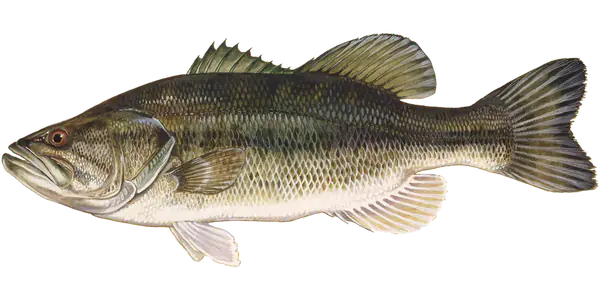
Largemouth bass: anything that fits
Largemouth Bass
Micropterus nigricans · Centrarchidae
- Freshwater
- Small fish
0.5 lb · 12 in
- Large fish
4.5 lb · 20 in
- Record fish
15 lb · 30 in
- Lifespan
Up to 15 years
Varies by water and conditions.
- Life cycle
Freshwater
Lives in fresh water its whole life.
- Diet
Predator
Feeds on fish, crayfish, large insects and frogs.
Data as a table
| Fish | Weight | Length |
|---|---|---|
| Small fish | 0.5 lb | 12 in |
| Large fish | 4.5 lb | 20 in |
| Record fish | 15 lb | 30 in |
| Fact | Value |
|---|---|
| Lifespan | Up to 15 years |
| Life cycle | Freshwater |
| Diet | PredatorFeeds on fish, crayfish, large insects and frogs. |
The South Carolina Department of Natural Resources follows the largemouth diet from birth: newly hatched bass feed on zooplankton, switch first to insects and then to larval and juvenile fish. Adults primarily eat other fish — threadfin and gizzard shad in large impoundments, sunfish in small ones — and the same agency sums the fish up as one that will consume any organism opportunity allows. In farm ponds stocked with bluegill and redear sunfish, largemouth control the bream population through predation, and Missouri’s guide calls the species almost invariably the principal predator stocked in farm ponds.
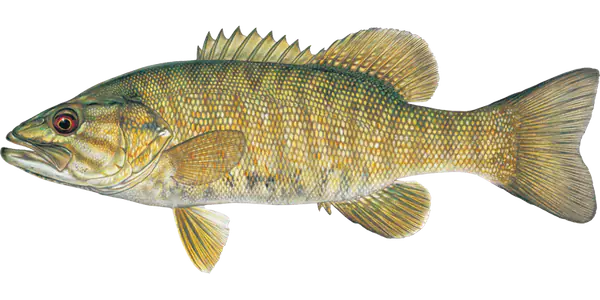
Smallmouth bass: crayfish, minnows and mayflies
Smallmouth Bass
Micropterus dolomieu · Centrarchidae
- Freshwater
- Small fish
0.5 lb · 11 in
- Large fish
4 lb · 18 in
- Record fish
11 lb · 27 in
- Lifespan
Up to 12 years
Varies by water and conditions.
- Life cycle
Freshwater
Lives in fresh water its whole life.
- Diet
Predator
Feeds on fish, crayfish and large aquatic insects.
Data as a table
| Fish | Weight | Length |
|---|---|---|
| Small fish | 0.5 lb | 11 in |
| Large fish | 4 lb | 18 in |
| Record fish | 11 lb | 27 in |
| Fact | Value |
|---|---|
| Lifespan | Up to 12 years |
| Life cycle | Freshwater |
| Diet | PredatorFeeds on fish, crayfish and large aquatic insects. |
Missouri records smallmouth fry starting on midge larvae and microcrustaceans and eating small fish before they are an inch long. Adults prowl the shoreline in quite shallow water when they hunt minnows, and the guide describes a habit worth knowing: smallmouth follow a large turtle or sucker as it roots in the bottom and pounce on any insects or crayfish it disturbs. At Bull Shoals they were the only one of the three to feed heavily on mayfly nymphs in spring.
Under 1 inch
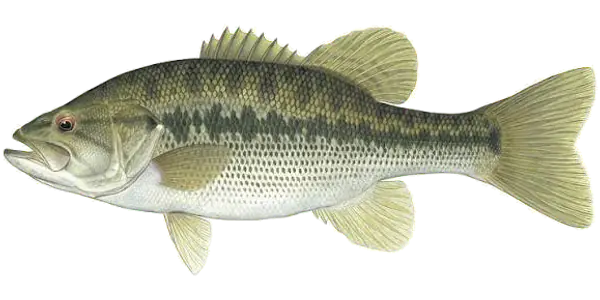
Spotted bass: the crayfish specialist
Spotted Bass
Micropterus punctulatus · Centrarchidae
- Freshwater
- Small fish
0.5 lb · 10 in
- Large fish
3.5 lb · 17 in
- Record fish
5 lb · 25 in
- Lifespan
Up to 6 years
Varies by water and conditions.
- Life cycle
Freshwater
Lives in fresh water its whole life.
- Diet
Predator
Feeds on crayfish, fish and immature aquatic insects.
Data as a table
| Fish | Weight | Length |
|---|---|---|
| Small fish | 0.5 lb | 10 in |
| Large fish | 3.5 lb | 17 in |
| Record fish | 5 lb | 25 in |
| Fact | Value |
|---|---|
| Lifespan | Up to 6 years |
| Life cycle | Freshwater |
| Diet | PredatorFeeds on crayfish, fish and immature aquatic insects. |
Spotted bass eat crayfish, fish and immature aquatic insects, and Missouri describes them catching prey by ambush from a hiding place, with the suction of a suddenly opened mouth doing part of the work. Bull Shoals put a number on the crayfish: 79% of their food by weight, the highest of the three, and the study called spotted bass the least piscivorous and perhaps the most selective feeders. Telling them from their two relatives is covered in largemouth vs smallmouth bass.
From diet to bait
Bait follows the food. Missouri names minnows, crayfish and hellgrammites as the most effective live baits for smallmouth and says the lures used for largemouth work on them too. The lure tables, season by season, are in how to catch largemouth bass and how to catch smallmouth bass.
For timing the dawn and dusk hours when bass feed, the comparison of fishing apps says which apps print solunar bite windows and which do not, and the wider species-by-water picture is in how to catch fish.